Higher Performance Insights | THE QUESTIONS I COULDN'T ANSWER IN 2025 (AND HOW I'D RESPOND TODAY)
January 14, 2026
higher performance insights

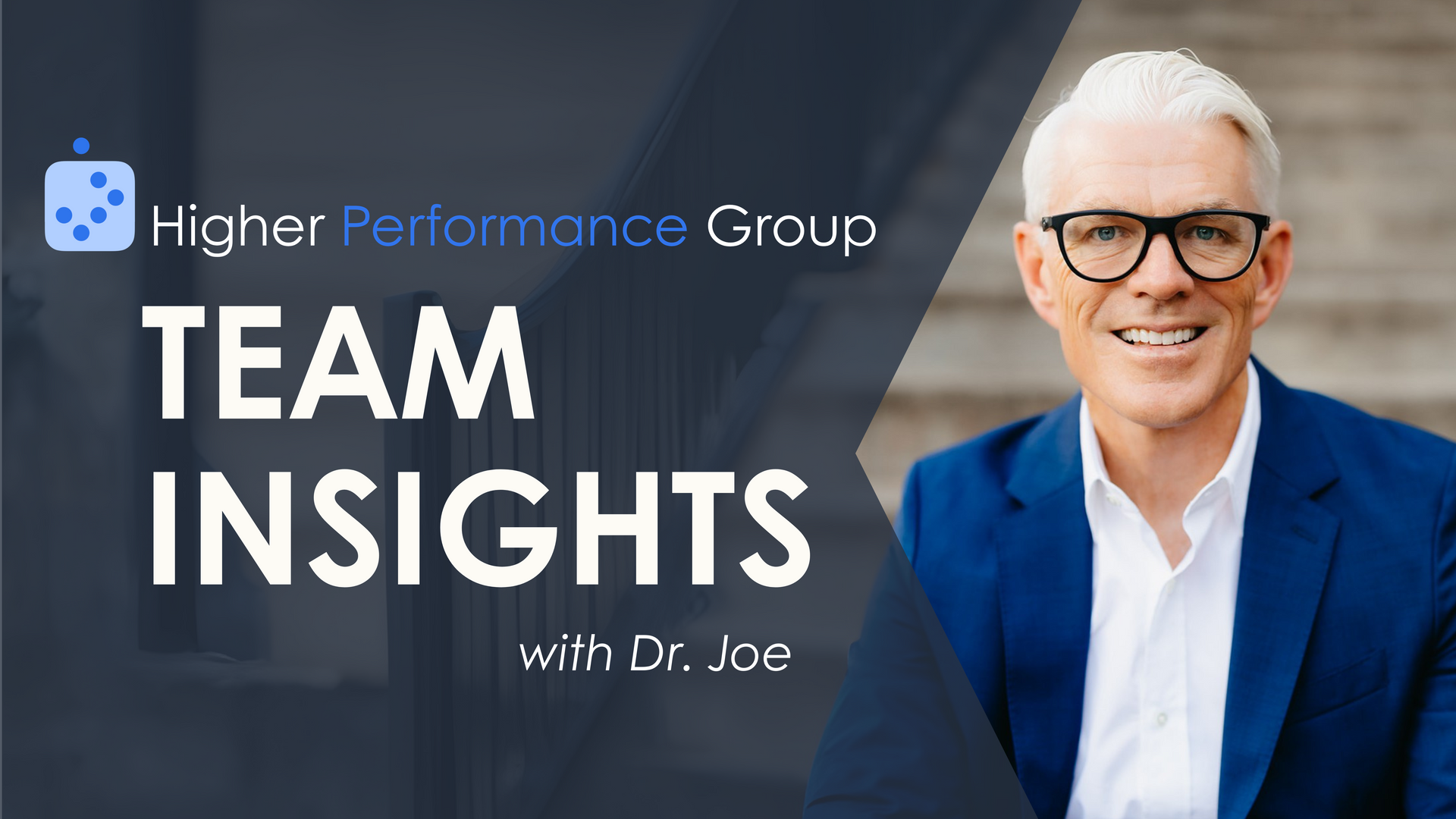
DR. JOE HILL President @HPG | Author of The TQ ADVANTAGE


When Your Board Metrics Say "Winning" But Your Gut Says "Failing"


I had the same conversation 23 times last year.


Not in conference keynotes, where everyone performs as a "strategic leader who has it figured out." In parking lots after workshops. On follow-up calls at 7 PM. In texts that started "Can I ask you something that's been eating at me?"


A superintendent, after crushing every board metric: "Joe, why do I feel like I'm failing at everything that actually matters?"


A university president with the most credentialed cabinet she's ever led: "We can't make a decision without three meetings.


What am I missing?"


A college president at 11 PM (via text): "I spend more time managing my cabinet's dysfunction than actually leading. How did I become this person?"


Here's what's frustrating: I gave terrible answers. Not because I'm incompetent—because these questions revealed problems I hadn't solved for myself.


So I spent Q4 doing what I should've done in Q1: figuring out what I should have said.


Turns out, the questions superintendents and presidents struggled with most in 2025 weren't about strategy, enrollment, or board politics. They were about survival while everyone watches you succeed.


Here are the three questions I botched—and the answers I wish I'd had ready.


QUESTION 1: "When Does Being Driven Cross Into Being Obsessive?"


The Moment I Realized I Had No Answer


Community college president—let's call her Rachel—after a Team Institute session:

"I'm in the office 6 AM to 7 PM. Weekends. My cabinet says I'm 'inspiring.' My spouse says I'm 'unavailable.' I thought this IS leadership. But am I driven or just addicted?"


I gave her the standard consultant answer about balance and boundaries.


It was garbage.


Because I was answering emails during our Netflix date night. I was "inspiring" my people while my wife wondered if I remembered her name. Glass houses, meet stones.


What I Figured Out By December


There's actual research on this—the dualistic model of passion:


Harmonious Passion:


  • Flexible and energizing
  • Fills you up
  • When you can't do it, you're disappointed but okay
  • Sustainable forever


Obsessive Passion:


  • Rigid persistence even when it's destroying you
  • When you can't do it, you feel shame
  • When you DO do it, you STILL feel inadequate
  • Major contributor to burnout (and divorce, and health crises your board will call "unexpected")


Campus leadership selects for obsessive passion and calls it "commitment." Your board rewards it. Your community celebrates it. Until someone has a breakdown, and everyone acts shocked.


The diagnostic? The Vacation Test.


Can you take a full day off without checking email?


If yes—when did you last actually do it?


If you can't remember, you're not driven. You're hyper-optimized. And hyper-optimization always precedes system failure. Ask any Formula One team that pushed too hard without pit stops.


💡 "The same drive that got you the presidency is the exact thing that will end it—unless you build recovery infrastructure around it before crisis forces the conversation."


What To Do Tuesday Morning (Not "Someday")


Pick ONE recovery ritual. Just one:


The Phone Kennel: Tonight, plug your phone downstairs. Don't bring it to your bedroom. (Sounds simple. Most presidents can't do it for three consecutive nights. That's diagnostic, not judgmental.)


The "This Area Is Clear" Ritual: When you leave your office, say out loud: "Work time is done." Creates a psychological boundary your brain actually respects.


The 3-Hour Sacred Window: Block three consecutive hours this weekend for something non-work that requires full attention. Coffee roasting. Long bike ride. Fiction reading. Playing with grandkids without your phone nearby.


If you take vacations and check email daily, that's work with a view, not recovery. Your body knows the difference even if your calendar doesn't.


Objection Handling:


"But I LIKE working—it's my passion!"


Great. Harmonious or obsessive? Can you stop without shame? That's the test.


"My board expects me to be available 24/7."


Your board expects you to lead for a decade, not flame out spectacularly in year three. They just haven't said it yet because you keep performing invincibility.


QUESTION 2: "My Cabinet Is Brilliant Individually But Collectively Incompetent. What's Broken?"


The Moment I Had No Good Answer


Superintendent in Texas—let's call him Marcus (Marcus, your CFO was laughing when we reviewed your Team Intelligence results, so you know this is you):


"Joe, every person on my cabinet has 15+ years of experience. Advanced degrees. Strategic thinkers. But together we can't make a simple decision without three pre-meetings and four follow-ups. What's broken?"


I said something generic about communication and trust.


Consultant garbage. The real answer? I hadn't figured out the math yet.


What I Figured Out By December


It's literally a math problem:


IQ × EQ × PQ = TQ


Most leadership cabinets look like this:


  • IQ (Individual Intelligence): 9.1/10 → You only hire brilliant people
  • EQ (Collective Emotional Intelligence): 3.8/10 → They can't disagree productively
  • PQ (Positional Intelligence—role clarity): 2.5/10 → Nobody knows who decides what
  • Result = TQ (Team Intelligence): 4.2/10 → Permanent impossibility despite impressive resumes


That's not a communication problem. That's a multiplication problem.


When any variable approaches zero, the whole equation collapses.


You keep investing in the variable that's already maxed out (IQ—hiring smart people) while ignoring the two that determine whether smart people can think together under pressure (EQ and PQ).


It's like installing a Ferrari engine with bicycle wheels and wondering why you're losing races to Honda Civics.


The pattern I've now seen 47 times:


Monday 6:30 AM: Your CFO wants to "align before Tuesday's meeting" (translation: lobby before anyone else can)

Tuesday 10 AM: Cabinet meeting where everyone performs collaboration while avoiding actual disagreement

Tuesday afternoon: Three separate "clarification" requests (translation: renegotiations of what seemed decided)

Friday: Everyone's exhausted, nothing's actually resolved, but calendars are impressively full, so at least it LOOKS like leadership is happening


That's a Team Intelligence deficit costing your district or institution roughly $1.1M annually in wasted meetings, duplicated effort, and opportunities missed while you're stuck in alignment purgatory.


Meanwhile, enrollment is shifting, your best teachers are wondering if leadership will ever actually lead, and your board is asking increasingly pointed questions about execution velocity.


💡 "Individual brilliance without Team Intelligence produces impressive LinkedIn profiles and permanent impossibility. The math doesn't care about your credentials."


What To Do Tuesday Morning


The Cabinet Intelligence Audit (15 minutes)


At your next cabinet meeting:


"Quick exercise. Everyone rate our team's ability to think together under pressure, 1-10. Write it privately first."

Go around the room. Read answers aloud.


If everyone says 8+: Somebody's lying (or everyone has wildly different definitions of "thinking together")

If answers vary by 3+ points: You don't share reality about your own team dynamics

If anyone says below 5: You've just identified why pre-meetings exist—people don't feel safe thinking out loud together

Then ask the question that changes everything:


"What would need to be true for everyone to feel comfortable disagreeing in THIS meeting instead of lobbying outside it?"

The silence will be uncomfortable. Someone will deflect with process talk. Someone else will say "I've been thinking the same thing."


That second person is your ally. Start there.


Objection Handling:


"We don't have time for this meta-conversation about meetings."

You spent 47 hours last month in meetings ABOUT meetings. You don't have time NOT to fix this. Your problem isn't time—it's Team Intelligence producing a 47-hour Meeting Tax.

"My team won't go for it—they'll think I'm criticizing them."


Your team is currently "going for" a system producing permanent friction despite everyone working 60-hour weeks. They already know something's broken. You're not revealing a problem—you're naming what everyone already feels.


QUESTION 3: "Why Do I Keep Neglecting What I Literally Teach Others?"


The Moment I Realized I'm A Hypocrite


This one's personal.


I teach Team Intelligence to superintendents and presidents. Sustainable systems. Recovery architecture. "You can't pour from an empty cup."


Then I worked through Thanksgiving. Answered emails Christmas morning. Ran on 5 hours of sleep and spite.


The question a superintendent asked me in October haunted me all through December:


"Joe, you teach this stuff. How do YOU avoid burning out?"


Honest answer? I wasn't. I was just better at hiding it.


What I Figured Out By December


I interviewed Dr. James Hewitt, a human performance scientist who works with Formula One teams.

He said something that gutted me:


"I taught recovery to Fortune 500 companies while being 'always on' myself. 100+ flights a year. Missing family dinners. I genuinely believed I was the exception to the rule—until one morning in the shower, I found a lump."


Cancer forced him to confront the truth: You're not superhuman. You're just a human who hasn't rested.


The most dangerous leadership belief isn't "I need to work harder."


It's "The rules don't apply to me."


They do. Physics doesn't care about your board's expectations, your strategic plan, or how many people are counting on you. Your body will force the conversation your calendar keeps postponing.


💡 "You're not too busy to build recovery systems. You're too busy BECAUSE you haven't built recovery systems. There's a difference."


What To Do Tuesday Morning


Design Your Weekly Recovery Day


Block ONE full day this week. Not "I'll try" or "maybe next week"—this week. Then:


Morning: Something requiring full attention but not work (bike ride, elaborate coffee ritual, whatever makes you feel human)

Afternoon: Something actively decreasing cognitive load (fiction, show-watching, napping—NOT business books or "personal development")


Evening: Time with people who don't need you to perform leadership

Critical Rules (Non-Negotiable):


  • Phone stays in another room (not "on silent"—physically elsewhere)
  • No "just checking email real quick" (that's work, which means you failed)
  • If you work at all, even "just for a minute," you failed the assignment


Objection Handling:


"But I have too much to do."


Then you've built an unsustainable system that will fail spectacularly—either next month or next year, but it WILL fail. Taking one day off either proves your cabinet can function without you (healthy) or reveals they can't (critical diagnostic you desperately need).


"What about emergencies?"


Define "emergency" as "can't wait 24 hours without significant harm to students, staff, or institution." Watch how shockingly few things meet that standard. Most "emergencies" are just someone else's poor planning becoming your crisis.

THE MATURITY SHIFT


Immature presidents think: "I just need more willpower, more passion, more drive. If I push harder, I'll break through."

Mature presidents think: "I need better systems, clearer boundaries, sustainable practices that multiply capacity without multiplying hours."

Immature superintendents optimize themselves to death while their cabinets watch and learn that sustainable leadership is performance art.

Mature superintendents build infrastructure that multiplies cabinet capacity without heroic individual effort.

The difference isn't motivation. It's systems.


One makes you busy. One makes you effective. One gives you an impressive calendar screenshot. One gives you a decade. One makes you a cautionary tale. One makes you a model worth following.


Your turn: Which question hit hardest? What are you specifically changing Tuesday morning?

Not "I need better balance"—that's consultant-speak performance art.


Be specific:


  • "I'm blocking Sunday completely. Phone stays downstairs."
  • "I'm running the Cabinet Intelligence Audit this week."
  • "I'm designing my first full recovery day for Saturday."


Drop a comment. Tag another superintendent or president who's crushing metrics while quietly drowning. Repost with your one specific action.


Because insight without implementation is just expensive entertainment that changes nothing.


STOP LEAVING PERFORMANCE ON THE TABLE


Here's what I've learned after working with 987 leadership teams:


Your team isn't broken. Your team model is.


You've invested millions in hiring brilliant individuals. But individual brilliance without Team Intelligence produces impressive resumes and permanent friction.


The superintendents and presidents who've cracked this code aren't working harder. They're working human—with recovery systems, Team Intelligence architecture, and the courage to admit that sustainable leadership requires more than inspiration and long hours.


If your talented team is performing at 60% capacity despite everyone's best efforts, the problem isn't motivation or competence.


It's multiplication: IQ × EQ × PQ = TQ


And when any variable approaches zero, your entire equation collapses—no matter how impressive your board reports look.


The TQ Keynote: Transform Your Team From Friction to Acceleration


This isn't another motivational talk about working together better.


This is the math, the research, and the practical protocols that help leadership teams move from 60% to 90%+ capacity—not by working harder, but by thinking together.


What You'll Discover:


  • The TQ equation that reveals exactly where your team is stuck (and why traditional development hasn't fixed it)
  • Five cognitive "BEST FIT" types every high-performing team needs (and which ones you're missing)
  • Practical protocols for transforming cabinet friction into execution acceleration
  • How to navigate complexity 40% faster than average teams (verified across 1,000+ leadership teams)
  • Live team mapping exercises using actual TQ types from your cabinet


This keynote is grounded in:


  • Analysis of nearly 1,000 leadership teams across K-12 and higher education
  • Research-backed insights showing 2:1 performance advantage for high-TQ teams
  • A practical framework that creates measurable results within 90 days, not "someday"


Duration: 2 hours Format: On-site with your full leadership team Investment: Book a conversation to discuss


Why This Is Different


94% of executives believe collaboration is critical.


Only 8% see results from traditional team development programs.


TQ bridges that gap—because it treats team development as a math problem with a systems solution, not a motivation problem with an inspiration band-aid.


Teams working with HPG consistently move from 60% to 90%+ capacity.


We protect that standard by choosing partners carefully. If your team is talented but stuck, if you're crushing board metrics while quietly drowning, if you've tried everything except addressing the actual multiplication problem—let's talk.


Book a TQ Keynote Conversation →Your community deserves leaders who multiply each other's strengths instead of working around each other's weaknesses.


Your talented individuals can become an unstoppable team.


But not with the same model that got you here.


Book Your TQ Keynote Today! - https://www.higherperformancegroup.com/team-intelligence-keynote


P.S. Stop Performing Sustainability. Start Practicing It.


The questions I couldn't answer in 2025 revealed my own gaps—in recovery systems, in Team Intelligence, in sustainable leadership architecture.


The answers I found by December might close yours—if you actually implement them instead of just nodding along.


Your cabinet is watching how you lead yourself. Your family is waiting for the version of you that comes home fully present. Your future self is begging you to build better systems before crisis forces the conversation.


Whether you book the keynote or not: Stop leaving 40% of your team's capacity on the table while everyone works 60-hour weeks.


The math is solvable. The systems are buildable. The question is whether you'll address it Tuesday or wait until Friday's crisis forces your hand.


Next Issue: "Your Cabinet Doesn't Need Another Retreat—They Need Recovery Architecture"


How one superintendent cut meetings 61% and increased results 3x. Not by working harder. By working human.


Follow DR. JOE HILL and Higher Performance Group for insights that close the knowing-doing gap.


Help Spread the Word

If you found value in this post, we’d love your help spreading the word! Please consider sharing this on your favorite social media platform and tag Higher Performance Group and Dr. Joe Hill. Your support helps us reach and inspire more awesome people like you!

Like What You've Read?


Get practical, research-based ideas to Accelerate Higher Team Performance delivered straight to your inbox every Tuesday.

More Blog Articles
By HPG Info April 14, 2026
Special Edition: Peer-2-Peer Leadership Roundtable Recap The Builder posture toward disruption — straight from the leaders living it. The loneliest job in American education is an absolute privilege... Said very few superintendents, college presidents, VPs, or provosts. On April 1, eight of them found that room of agreement. A 2025 National Superintendent of the Year. A president rebuilding a community college that guidance counselors told students to avoid. A rural Minnesota superintendent who started teaching kindergartners to code because his state ranked 50th nationally in computer science. A Chicago-area superintendent building partnerships with the private schools his system was architecturally designed to compete against. Sixty minutes. No presentations. No panels. No consultant with a slide deck and a solution. Just the conversation most of them cannot have inside their own institutions — because inside their own institutions, the people in the room report to them. "The pain of this office is a privilege. The reason we bring people into this space is to keep us all propped up, because it's so very important. And it gets pretty lonely in that space — you can't talk about some of the things you're dealing with." — DR. JOE HILL , Host & Founder, Higher Performance Group Here is what they said. And what it demands of your cabinet Monday morning. THE DIAGNOSIS You've Been Treating a Structural Problem Like a Personnel Problem Three numbers opened the session. Not for drama. As ground truth. 1.7 million students lost from higher education since 2010. 1.2 million students lost from K–12 public schools since 2019. $248 billion in global e-learning market growing at 14.2% annually — most of it flowing toward providers who are not you. Then the line most leadership conferences spend three days dancing around: Students and families are not rejecting education. They are rejecting institutional education that has failed to keep pace. The leaders in that room didn't push back. They exhaled. Because they'd been carrying that sentence alone. The instinct when outcomes disappoint is to look at people. Who isn't executing? Who needs to be moved? Our research across 987 leadership teams says that's the wrong question: Most underperformance in educational institutions is not a talent failure. It is a structural failure wearing a talent problem's clothes. The meeting culture that trained your cabinet to manage the temperature instead of the truth. The planning process that produces alignment in October and confusion in March. The decision architecture that routes everything through the leader instead of building collective judgment. None of that shows up in a performance review. All of it shows up in your outcomes. (This is the specific gap THE TEAM INSTITUTE closes — not by optimizing individuals, but by building the collective architecture that allows your best people to actually build. More on that in a moment.) THE FRAMEWORK The Builder Matrix: Which Room Is Your Cabinet Living In? Dr. Hill opened the session with a diagnostic frame that participants returned to throughout the conversation. In any institution navigating disruption, four behavioral types emerge — and they are not personality traits. They are responses to the structural conditions you have built. Builders advance the mission, navigate structural friction, and pay clarity costs others won't. They name what's broken in the room where it's produced. Dreamers are aspirationally aligned and inconsistently present. They describe the future beautifully. Their follow-through is conditional. Climbers contribute strategically to their own advancement. Not malicious — misaligned. They are excellent readers of what the system rewards and respond accordingly. Coasters occupy resources without returning them. They exited emotionally long before they exit physically. Most institutions have more of these than they know — because the system stopped demanding otherwise. The institutions losing students fastest are not the ones with the worst people. They are the ones with the worst structural conditions for their best people. In a volatile, brittle, rapidly shifting environment — a system optimized for Coasters is not just inefficient. It is existentially dangerous. And the Builders inside it are quietly calculating whether the cost of staying is still worth paying. If you recognize your cabinet in the Builder Matrix — and you suspect the weight is sitting in the wrong quadrants — that's the conversation THE TEAM INSTITUTE was built for. Eight months. Sequential development. The structural conditions that allow Builders to build and stop converting Dreamers into Coasters by accident. Whether you work with us or not, here's what the eight leaders in that room figured out. WHAT THE BUILDERS SAID Theme One: Engagement Is the Diagnostic — and Most Institutions Are Reading It Wrong The word that surfaced most consistently was engagement — not as aspiration, but as a measurable gap between what educators believe is happening and what students actually experience. "We did a survey — we asked principals, teachers, and students about engagement. Principals and teachers rated it very high. Students rated it very low. That was a real aha for us." — Dr. Rick Surrency , Superintendent, Putnam County Schools, Florida · 2025 National Superintendent of the Year This is not a Putnam County problem. The gap between administrator belief and student experience is not a communication failure — it is a structural one. Dreamers respond to that survey by improving the narrative. Builders redesign the experience. Dr. Dana Monogue connected the engagement failure directly to structural irrelevance: most of what students are asked to do has no visible connection to their lives or the economy they're entering. "I'm on a personal mission to completely transform the American high school experience. It's just archaic. There are many great models across the country, and I'm trying to learn from as many as possible." — Dr. Dana Monogue, Superintendent, Middleton-Cross Plains Area School District, Wisconsin Dr. Christine Mangino named the same gap from higher education — and named the specific humans producing it. "I don't think guidance counselors in high schools respect community colleges. The things our students were told by their guidance counselors as they were applying to us are horrifyingly painful. It is not okay." — Dr. Christine Mangino, President, Queensborough Community College, New York Theme Two: The K–12 and Higher Education Silo Is the Most Expensive Wall Nobody Maps The most consequential silo in American education doesn't appear on any institution's org chart. It exists between institutions — K–12 and higher education serving the same students with funding formulas that reward separation. "The system has been set up against us to partner with charter, private, independent, religious, micro, home, virtual, and community college. Part of it goes to the entire system of segregated practices that have been codified since 1975." — Dr. Michael Lubelfeld , Superintendent, North Shore School District 112, Illinois Dr. Monogue named the most actionable move in the room: taking sophomore students and staff together to the local community college. Not students alone. Staff. "We need to equip not just our counselors but our teachers" — because teachers shape what students believe is possible after graduation, and most of them have never set foot on a community college campus. Theme Three: AI Is Not a Future Conversation Several participants described AI integration already operational. The range was instructive — from kindergarten coding pipelines in rural Minnesota to AI certification programs launched through a single university partnership in Florida. "We start in kindergarten. We've worked with Jump to create an innovation hub at our middle-senior high school. What we're doing is helping bridge opportunities so that what kids learn in coding applies to something real." — Liam Dawson , Superintendent, St. James Public Schools, Minnesota "We partnered with Columbia University. A professor taught our students about AI at no charge. The teacher eventually became certified in AI. From that teacher, five more became certified. From those teachers, students became certified." — Dr. Rick Surrency, Superintendent, Putnam County Schools, Florida The pattern: Builders find the one person who multiplies. One relationship, scaled. AI integration is a partnership decision, not a curriculum decision. Districts moving fastest have cross-sector relationships already in place. Those without them move at the speed of procurement. That is not fast enough. Theme Four: Vouchers and Choice Are Not a Future Threat. They Are a Present Design Brief. "Out of 10,000 students, over the last several years, we've lost about 900 kids. They are taking their money with them, right out of our budget. We've closed five schools. Every single superintendent in Florida is dealing with this." — Dr. Rick Surrency, Superintendent, Putnam County Schools, Florida "The Alpha School opening in Chicago may not be an existential threat to the public school system. I don't need to judge its merits. What I need to ask is: is there something they're doing that I should be doing? And if so, what's stopping me?" — Dr. Michael Lubelfeld, Superintendent, North Shore School District 112, Illinois Dr. Dr. Nathan S. Schilling, CSBO , whose pre-K–8 Illinois district is structurally separated from the local high school district, named what that wall actually looks like at the student level: "The eighth-to-ninth grade transition in my district happens across a district boundary, not just a building. That means multiple walls, each one adding friction — and none of them appearing on any single institution's org chart." — Dr. Nathan Schilling, Superintendent, Lansing School District 158, Illinois That's not a communication problem between buildings. It's a design problem between systems — and no single leader owns it, which means no single leader fixes it. The Builder response is not to lobby against choice. It is to build something families choose. Your institution is a brand that either generates word of mouth or doesn't. Act accordingly. Theme Five: Teaching People to Teach Is the Faculty Development Gap Nobody Advertises "Faculty are often hired on their scholarship, not necessarily on their teaching. We've invested in the Association of College and University Educators. We've had 400 faculty — full time and part time — go through that program. It's been transformational." — Dr. Catherine Wehlburg, Ph.D. , President, Athens State University, Alabama Athens State's prior learning assessment system gives students credit for verifiable industry credentials. The principle: don't make people sit in a class learning something they already know how to do. The compliance resistance to that idea is enormous. Wehlburg built it anyway. THE PATTERN What Builders Do Differently Across five themes and sixty minutes, a behavioral pattern emerged. The distinction between the Builders in this room and Dreamers describing similar goals was not aspiration. It was action architecture: They cross the wall rather than study it. Surrency partnered with Columbia. Monogue brought teachers to college campuses. Wehlburg built prior learning assessment inside a compliance architecture designed to prevent it. Lubelfeld is building bridges to institutions his system was designed to compete against. They measure what students experience — not what administrators believe. The engagement survey that revealed the gap between teacher perception and student reality is the example. Dreamers believe their read is accurate. Builders go find out. They use enrollment loss as design data. Closing five schools is painful. Closing five schools and restructuring to improve the student experience is a Builder move. The loss is the input, not the verdict. They name the constraint out loud. Mangino named the transfer credit wall in a room of K–12 leaders who had no idea it existed. Most leaders describe symptoms. Builders name the structural source — in the room where it's produced. They find the one person who multiplies. Surrency's AI teacher certified other teachers. Dawson's Jump partnership produced an innovation hub. One relationship, scaled intentionally. This is not luck. It is a resource allocation strategy. They give students real work with real consequences. Not engagement activities. Structural signals about who the work is actually for. MONDAY MORNING Three Moves. This Week. One: Run the Builder Matrix Audit on Your Cabinet Twenty minutes. Alone. Before the week finds you. For each cabinet member: where are they operating right now — and is that a reflection of who they are, or a reflection of what your system has been rewarding? Then ask the harder version: which quadrant are you occupying as the leader? The quadrant you operate from sets the ceiling for every quadrant on your team. A Climber at the top produces a cabinet of strategic Climbers. A Builder at the top creates structural permission for Builders to surface. Two: Name One Structural Condition — Not One Person — That Is Producing Your Worst Outcome In your next cabinet meeting. Not "we need better execution." Something specific and structural. The meeting format that routes every decision through you and trains your team not to think collectively. The planning process that produces alignment in October and confusion in March. When a leader names a structural problem instead of a personnel problem, two things happen: the people quietly blaming themselves exhale — and the people benefiting from the dysfunction get uncomfortable. Both reactions are data. Three: Find Your Builders and Tell Them What You See This week. Individually. Not in a group setting. Builders stay when they believe the cost of staying is worth paying. They leave when they conclude the structural friction is permanent, and nobody with authority sees what they see. You don't need a program to keep your Builders. You need fifteen minutes, their name, and the specific thing you watched them do that mattered. That conversation may be the highest-ROI investment you make this month. THE MATURITY SHIFT Immature leaders think: "If I had better people, I'd have better outcomes." Mature leaders think: "If I had a better system, I'd know which people were actually Builders — and I'd have stopped converting them into Dreamers years ago." Immature leaders run personnel strategies on structural problems. They move the Climbers up, wait the Coasters out, and wonder why the Builders keep leaving. Mature leaders understand that the quadrant distribution in their cabinet is a mirror of the system they've built — and changing the distribution starts with changing the architecture, not the org chart. The 987 leadership teams in our research who moved from 60% capacity to 90% didn't get there by finding better people. They got there by building the structural conditions that allowed the people they already had to operate as Builders. TQ = IQ × EQ × PQ. When the architecture collapses the PQ dimension toward zero, the equation collapses — regardless of how talented the individuals are. Your turn: which quadrant is your cabinet's center of gravity right now? One word. Drop it in the comments. Not as a verdict on your people. As a starting point for the structural conversation that changes it. Tag a Builder on your team — someone you've watched pay clarity costs nobody asked them to pay. They deserve to know you noticed. THE TEAM INSTITUTE The Builder Matrix tells you where the weight is sitting. It doesn't tell you how to move it. That is the work of THE TEAM INSTITUTE. Eight months. Sequential development. Not individual optimization — collective architecture. The trust infrastructure that makes it safe to operate as a Builder. The shared language that makes structural problems nameable in the room where they're produced. The accountability framework that turns insight into institutional change rather than parking-lot conversation. From our research across 987 leadership teams: 3x performance improvement. 29% higher engagement. 27% better organizational outcomes. Zero burnout increase. One requirement: full cabinet participation. You cannot build a Builder's architecture with half a cabinet in the room. Schedule a consultation: https://www.higherperformancegroup.com/team-institute# JOIN THE NEXT ROUNDTABLE · JUNE 3, 2026 You Were Never Meant to Figure This Out Alone. Here is what the April 1 session was not: It was not a conference. Nobody had a keynote. It was not a workshop. Nobody had a workbook. It was not a webinar. Nobody was selling the next program. Here is what it was: senior educational leaders who lead districts of 600 students and colleges of 11,000, from Montana to New York to Florida, sitting in the same room long enough to stop performing and start talking. They surfaced things they cannot name inside their own institutions — because inside their own institutions, the people in the room report to them. The enrollment losses. The faculty dynamics. The board pressure. The cabinet that has learned to give them the version of reality that doesn't cost anything. Sixty minutes later, they left with commitments. Not aspirational ones — specific, named, accountable ones. June 3, 2026 · 10:30 AM CST · 60 Minutes · No cost to attend Topic: Unbuilding the Silos — From Program-Centered Institutions to Partnership-Driven Ecosystems If you are a superintendent, president, provost, or cabinet-level leader who is tired of being the smartest person in a room full of people who report to you — this is the room you have been looking for. Reserve your seat: higherperformancegroup.com/p2p-page FOUND VALUE IN THIS? Help other educational leaders find it: Repost with your answer to the Builder Matrix question: which quadrant is your cabinet's center of gravity right now? Real answers from real leaders are more useful than any framework. Tag a Builder — someone you've watched stay in the work when the structural friction made leaving the easier choice. Name them specifically. They deserve to hear it publicly. Comment with one structural condition — not one person — that you are done letting produce the outcomes it has been producing. The more educational leaders who move from personnel strategies to structural ones, the better our institutions become. Follow DR. JOE HILL and Higher Performance Group for weekly Team Intelligence insights.
By HPG Info April 7, 2026
Special Edition: Peer-2-Peer Leadership Roundtable Recap The Builder posture toward disruption — straight from the leaders living it. The loneliest job in American education is an absolute privilege... Said very few superintendents, college presidents, VPs, or provosts. On April 1, eight of them found that room of agreement. A 2025 National Superintendent of the Year. A president rebuilding a community college that guidance counselors told students to avoid. A rural Minnesota superintendent who started teaching kindergartners to code because his state ranked 50th nationally in computer science. A Chicago-area superintendent building partnerships with the private schools his system was architecturally designed to compete against. Sixty minutes. No presentations. No panels. No consultant with a slide deck and a solution. Just the conversation most of them cannot have inside their own institutions — because inside their own institutions, the people in the room report to them. "The pain of this office is a privilege. The reason we bring people into this space is to keep us all propped up, because it's so very important. And it gets pretty lonely in that space — you can't talk about some of the things you're dealing with." — DR. JOE HILL , Host & Founder, Higher Performance Group Here is what they said. And what it demands of your cabinet Monday morning. THE DIAGNOSIS You've Been Treating a Structural Problem Like a Personnel Problem Three numbers opened the session. Not for drama. As ground truth. 1.7 million students lost from higher education since 2010. 1.2 million students lost from K–12 public schools since 2019. $248 billion in global e-learning market growing at 14.2% annually — most of it flowing toward providers who are not you. Then the line most leadership conferences spend three days dancing around: Students and families are not rejecting education. They are rejecting institutional education that has failed to keep pace. The leaders in that room didn't push back. They exhaled. Because they'd been carrying that sentence alone. The instinct when outcomes disappoint is to look at people. Who isn't executing? Who needs to be moved? Our research across 987 leadership teams says that's the wrong question: Most underperformance in educational institutions is not a talent failure. It is a structural failure wearing a talent problem's clothes. The meeting culture that trained your cabinet to manage the temperature instead of the truth. The planning process that produces alignment in October and confusion in March. The decision architecture that routes everything through the leader instead of building collective judgment. None of that shows up in a performance review. All of it shows up in your outcomes. (This is the specific gap THE TEAM INSTITUTE closes — not by optimizing individuals, but by building the collective architecture that allows your best people to actually build. More on that in a moment.) THE FRAMEWORK The Builder Matrix: Which Room Is Your Cabinet Living In? Dr. Hill opened the session with a diagnostic frame that participants returned to throughout the conversation. In any institution navigating disruption, four behavioral types emerge — and they are not personality traits. They are responses to the structural conditions you have built. Builders advance the mission, navigate structural friction, and pay clarity costs others won't. They name what's broken in the room where it's produced. Dreamers are aspirationally aligned and inconsistently present. They describe the future beautifully. Their follow-through is conditional. Climbers contribute strategically to their own advancement. Not malicious — misaligned. They are excellent readers of what the system rewards and respond accordingly. Coasters occupy resources without returning them. They exited emotionally long before they exit physically. Most institutions have more of these than they know — because the system stopped demanding otherwise. The institutions losing students fastest are not the ones with the worst people. They are the ones with the worst structural conditions for their best people. In a volatile, brittle, rapidly shifting environment — a system optimized for Coasters is not just inefficient. It is existentially dangerous. And the Builders inside it are quietly calculating whether the cost of staying is still worth paying. If you recognize your cabinet in the Builder Matrix — and you suspect the weight is sitting in the wrong quadrants — that's the conversation THE TEAM INSTITUTE was built for. Eight months. Sequential development. The structural conditions that allow Builders to build and stop converting Dreamers into Coasters by accident. Whether you work with us or not, here's what the eight leaders in that room figured out. WHAT THE BUILDERS SAID Theme One: Engagement Is the Diagnostic — and Most Institutions Are Reading It Wrong The word that surfaced most consistently was engagement — not as aspiration, but as a measurable gap between what educators believe is happening and what students actually experience. "We did a survey — we asked principals, teachers, and students about engagement. Principals and teachers rated it very high. Students rated it very low. That was a real aha for us." — Dr. Rick Surrency , Superintendent, Putnam County Schools, Florida · 2025 National Superintendent of the Year This is not a Putnam County problem. The gap between administrator belief and student experience is not a communication failure — it is a structural one. Dreamers respond to that survey by improving the narrative. Builders redesign the experience. Dr. Dana Monogue connected the engagement failure directly to structural irrelevance: most of what students are asked to do has no visible connection to their lives or the economy they're entering. "I'm on a personal mission to completely transform the American high school experience. It's just archaic. There are many great models across the country, and I'm trying to learn from as many as possible." — Dr. Dana Monogue, Superintendent, Middleton-Cross Plains Area School District, Wisconsin Dr. Christine Mangino named the same gap from higher education — and named the specific humans producing it. "I don't think guidance counselors in high schools respect community colleges. The things our students were told by their guidance counselors as they were applying to us are horrifyingly painful. It is not okay." — Dr. Christine Mangino, President, Queensborough Community College, New York Theme Two: The K–12 and Higher Education Silo Is the Most Expensive Wall Nobody Maps The most consequential silo in American education doesn't appear on any institution's org chart. It exists between institutions — K–12 and higher education serving the same students with funding formulas that reward separation. "The system has been set up against us to partner with charter, private, independent, religious, micro, home, virtual, and community college. Part of it goes to the entire system of segregated practices that have been codified since 1975." — Dr. Michael Lubelfeld , Superintendent, North Shore School District 112, Illinois Dr. Monogue named the most actionable move in the room: taking sophomore students and staff together to the local community college. Not students alone. Staff. "We need to equip not just our counselors but our teachers" — because teachers shape what students believe is possible after graduation, and most of them have never set foot on a community college campus. Theme Three: AI Is Not a Future Conversation Several participants described AI integration already operational. The range was instructive — from kindergarten coding pipelines in rural Minnesota to AI certification programs launched through a single university partnership in Florida. "We start in kindergarten. We've worked with Jump to create an innovation hub at our middle-senior high school. What we're doing is helping bridge opportunities so that what kids learn in coding applies to something real." — Liam Dawson , Superintendent, St. James Public Schools, Minnesota "We partnered with Columbia University. A professor taught our students about AI at no charge. The teacher eventually became certified in AI. From that teacher, five more became certified. From those teachers, students became certified." — Dr. Rick Surrency, Superintendent, Putnam County Schools, Florida The pattern: Builders find the one person who multiplies. One relationship, scaled. AI integration is a partnership decision, not a curriculum decision. Districts moving fastest have cross-sector relationships already in place. Those without them move at the speed of procurement. That is not fast enough. Theme Four: Vouchers and Choice Are Not a Future Threat. They Are a Present Design Brief. "Out of 10,000 students, over the last several years, we've lost about 900 kids. They are taking their money with them, right out of our budget. We've closed five schools. Every single superintendent in Florida is dealing with this." — Dr. Rick Surrency, Superintendent, Putnam County Schools, Florida "The Alpha School opening in Chicago may not be an existential threat to the public school system. I don't need to judge its merits. What I need to ask is: is there something they're doing that I should be doing? And if so, what's stopping me?" — Dr. Michael Lubelfeld, Superintendent, North Shore School District 112, Illinois Dr. Dr. Nathan S. Schilling, CSBO , whose pre-K–8 Illinois district is structurally separated from the local high school district, named what that wall actually looks like at the student level: "The eighth-to-ninth grade transition in my district happens across a district boundary, not just a building. That means multiple walls, each one adding friction — and none of them appearing on any single institution's org chart." — Dr. Nathan Schilling, Superintendent, Lansing School District 158, Illinois That's not a communication problem between buildings. It's a design problem between systems — and no single leader owns it, which means no single leader fixes it. The Builder response is not to lobby against choice. It is to build something families choose. Your institution is a brand that either generates word of mouth or doesn't. Act accordingly. Theme Five: Teaching People to Teach Is the Faculty Development Gap Nobody Advertises "Faculty are often hired on their scholarship, not necessarily on their teaching. We've invested in the Association of College and University Educators. We've had 400 faculty — full time and part time — go through that program. It's been transformational." — Dr. Catherine Wehlburg, Ph.D. , President, Athens State University, Alabama Athens State's prior learning assessment system gives students credit for verifiable industry credentials. The principle: don't make people sit in a class learning something they already know how to do. The compliance resistance to that idea is enormous. Wehlburg built it anyway. THE PATTERN What Builders Do Differently Across five themes and sixty minutes, a behavioral pattern emerged. The distinction between the Builders in this room and Dreamers describing similar goals was not aspiration. It was action architecture: They cross the wall rather than study it. Surrency partnered with Columbia. Monogue brought teachers to college campuses. Wehlburg built prior learning assessment inside a compliance architecture designed to prevent it. Lubelfeld is building bridges to institutions his system was designed to compete against. They measure what students experience — not what administrators believe. The engagement survey that revealed the gap between teacher perception and student reality is the example. Dreamers believe their read is accurate. Builders go find out. They use enrollment loss as design data. Closing five schools is painful. Closing five schools and restructuring to improve the student experience is a Builder move. The loss is the input, not the verdict. They name the constraint out loud. Mangino named the transfer credit wall in a room of K–12 leaders who had no idea it existed. Most leaders describe symptoms. Builders name the structural source — in the room where it's produced. They find the one person who multiplies. Surrency's AI teacher certified other teachers. Dawson's Jump partnership produced an innovation hub. One relationship, scaled intentionally. This is not luck. It is a resource allocation strategy. They give students real work with real consequences. Not engagement activities. Structural signals about who the work is actually for. MONDAY MORNING Three Moves. This Week. One: Run the Builder Matrix Audit on Your Cabinet Twenty minutes. Alone. Before the week finds you. For each cabinet member: where are they operating right now — and is that a reflection of who they are, or a reflection of what your system has been rewarding? Then ask the harder version: which quadrant are you occupying as the leader? The quadrant you operate from sets the ceiling for every quadrant on your team. A Climber at the top produces a cabinet of strategic Climbers. A Builder at the top creates structural permission for Builders to surface. Two: Name One Structural Condition — Not One Person — That Is Producing Your Worst Outcome In your next cabinet meeting. Not "we need better execution." Something specific and structural. The meeting format that routes every decision through you and trains your team not to think collectively. The planning process that produces alignment in October and confusion in March. When a leader names a structural problem instead of a personnel problem, two things happen: the people quietly blaming themselves exhale — and the people benefiting from the dysfunction get uncomfortable. Both reactions are data. Three: Find Your Builders and Tell Them What You See This week. Individually. Not in a group setting. Builders stay when they believe the cost of staying is worth paying. They leave when they conclude the structural friction is permanent, and nobody with authority sees what they see. You don't need a program to keep your Builders. You need fifteen minutes, their name, and the specific thing you watched them do that mattered. That conversation may be the highest-ROI investment you make this month. THE MATURITY SHIFT Immature leaders think: "If I had better people, I'd have better outcomes." Mature leaders think: "If I had a better system, I'd know which people were actually Builders — and I'd have stopped converting them into Dreamers years ago." Immature leaders run personnel strategies on structural problems. They move the Climbers up, wait the Coasters out, and wonder why the Builders keep leaving. Mature leaders understand that the quadrant distribution in their cabinet is a mirror of the system they've built — and changing the distribution starts with changing the architecture, not the org chart. The 987 leadership teams in our research who moved from 60% capacity to 90% didn't get there by finding better people. They got there by building the structural conditions that allowed the people they already had to operate as Builders. TQ = IQ × EQ × PQ. When the architecture collapses the PQ dimension toward zero, the equation collapses — regardless of how talented the individuals are. Your turn: which quadrant is your cabinet's center of gravity right now? One word. Drop it in the comments. Not as a verdict on your people. As a starting point for the structural conversation that changes it. Tag a Builder on your team — someone you've watched pay clarity costs nobody asked them to pay. They deserve to know you noticed. THE TEAM INSTITUTE The Builder Matrix tells you where the weight is sitting. It doesn't tell you how to move it. That is the work of THE TEAM INSTITUTE. Eight months. Sequential development. Not individual optimization — collective architecture. The trust infrastructure that makes it safe to operate as a Builder. The shared language that makes structural problems nameable in the room where they're produced. The accountability framework that turns insight into institutional change rather than parking-lot conversation. From our research across 987 leadership teams: 3x performance improvement. 29% higher engagement. 27% better organizational outcomes. Zero burnout increase. One requirement: full cabinet participation. You cannot build a Builder's architecture with half a cabinet in the room. Schedule a consultation: https://www.higherperformancegroup.com/team-institute# JOIN THE NEXT ROUNDTABLE · JUNE 3, 2026 You Were Never Meant to Figure This Out Alone. Here is what the April 1 session was not: It was not a conference. Nobody had a keynote. It was not a workshop. Nobody had a workbook. It was not a webinar. Nobody was selling the next program. Here is what it was: senior educational leaders who lead districts of 600 students and colleges of 11,000, from Montana to New York to Florida, sitting in the same room long enough to stop performing and start talking. They surfaced things they cannot name inside their own institutions — because inside their own institutions, the people in the room report to them. The enrollment losses. The faculty dynamics. The board pressure. The cabinet that has learned to give them the version of reality that doesn't cost anything. Sixty minutes later, they left with commitments. Not aspirational ones — specific, named, accountable ones. June 3, 2026 · 10:30 AM CST · 60 Minutes · No cost to attend Topic: Unbuilding the Silos — From Program-Centered Institutions to Partnership-Driven Ecosystems If you are a superintendent, president, provost, or cabinet-level leader who is tired of being the smartest person in a room full of people who report to you — this is the room you have been looking for. Reserve your seat: higherperformancegroup.com/p2p-page FOUND VALUE IN THIS? Help other educational leaders find it: Repost with your answer to the Builder Matrix question: which quadrant is your cabinet's center of gravity right now? Real answers from real leaders are more useful than any framework. Tag a Builder — someone you've watched stay in the work when the structural friction made leaving the easier choice. Name them specifically. They deserve to hear it publicly. Comment with one structural condition — not one person — that you are done letting produce the outcomes it has been producing. The more educational leaders who move from personnel strategies to structural ones, the better our institutions become. Follow DR. JOE HILL and Higher Performance Group for weekly Team Intelligence insights.
Show More